




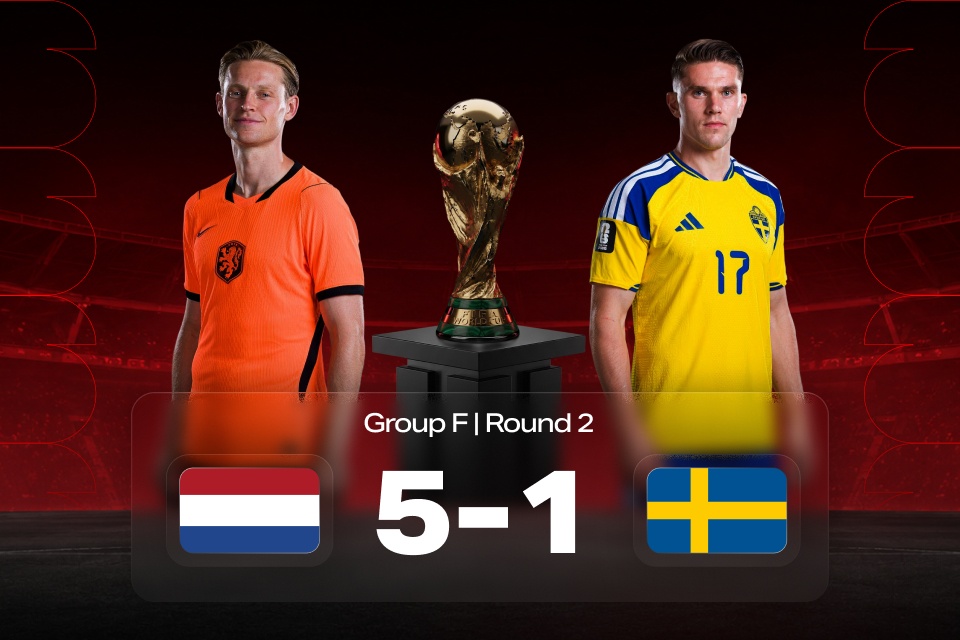


Before kick-off, the Netherlands were priced as favourites at 1.73, and the 888STARZ line read the general balance of power quite well. This was not an ultra-short favourite price, but the market still gave the Dutch a clear edge. The draw was listed at 3.98, while Sweden were priced at 5.33 to win.
On the pitch, the Netherlands confirmed that favourite status far more convincingly than the cautious pre-match line suggested. They beat Sweden 5-1, scored twice inside the opening 17 minutes and quickly moved the game into a scenario that suited them perfectly.
Sweden only found a way back onto the scoresheet through Elanga in the 59th minute, but by then the score was already 4-0. That goal changed the scoreboard, not the logic of the match. The Netherlands controlled the tempo, space and quality of chances for almost the entire game.
Match: Netherlands vs Sweden
Result: 5-1
888STARZ odds: 1.73 / 3.98 / 5.33
Goals and Key Moments
1-0 — Brobbey, 5’
2-0 — Brobbey, 17’
3-0 — Gakpo, 47’
4-0 — Gakpo, 54’
4-1 — Elanga, 59’
5-1 — Summerville, 89’
The Line Had the Netherlands as Clear Favourites
The 1.73 price on the Netherlands showed that the market expected a Dutch advantage, but did not treat the match as completely closed. That is an important detail. At this kind of price, the favourite is clearly stronger, but the line still leaves room for resistance from the opponent, a draw scenario or a more complicated one-goal win.
Sweden at 5.33 were obvious underdogs, but not a side with no chance at all. This kind of price usually means the market sees limits in the underdog’s ability to control the match, while still allowing for a possible scenario built around an early goal, set pieces, counterattacks or a drop in intensity from the favourite.
In this match, however, the alternative scenario disappeared very quickly. The Netherlands scored in the 5th minute, and Brobbey’s second goal in the 17th minute effectively broke the opening tension. From that point on, the match stopped being a balance test and became a question of how far the favourite could go.
Brobbey’s Early Brace Changed Everything
The decisive spell came in the first 17 minutes. Brobbey scored twice and gave the Netherlands the perfect betting scenario: the favourite confirmed their edge early, took control and forced Sweden into an uncomfortable game state.
Before the match, Sweden could have hoped for a calmer script: survive the early pressure, stop the Netherlands from building momentum and then look for chances through the flanks and transition attacks. At 0-2, that plan no longer worked.
Sweden had to push higher, take more risks and open up earlier than they wanted. For the Netherlands, that was a gift. There was more space between the lines, more room for quick attacks and more freedom for their attacking players.
That is why the early goals mattered beyond the scoreline. They completely changed the structure of the match.
Why This Scenario Was Perfect for the Favourite
A favourite priced at 1.73 can be tricky because they still need to confirm their edge on the pitch, not just on paper. If that kind of favourite goes too long without scoring, live odds can quickly become nervous, while the underdog gains belief.
Here, the opposite happened. The Netherlands scored early, doubled the lead quickly and removed the main risk — a stretched, low-tempo match in which Sweden could wait for one mistake or one isolated moment.
After 2-0, the Dutch no longer had to force the game at any cost. They could control possession, choose when to accelerate and punish Sweden for trying to chase the result. Gakpo’s goal in the 47th minute was a natural continuation of that script, and his second in the 54th turned the match into a rout.
The Netherlands Won the Tempo, Not Just the Scoreline
The final 5-1 scoreline does not look random. The Netherlands did not simply convert a few chances — they controlled the key phases of the match.
First, they started aggressively and scored early. Then they did not allow Sweden to settle after the opening blow. After half-time, the Netherlands started sharply again and scored twice in seven minutes. Even after Elanga’s goal, they did not lose focus and added a fifth through Summerville in the 89th minute.
For betting analysis, this is important. Sometimes a favourite wins big because the opponent collapses late. Here, the Netherlands were stronger across almost every key phase: the start, the beginning of the second half, the reaction after conceding and the closing stage.
Sweden Could Not Handle the Early Pressure
For Sweden, this match became painful because of the opening minutes. The team fell behind too early, and against the Netherlands that kind of scenario is almost always dangerous.
At 0-1, Sweden could still have stayed in their structure and looked for a way back. But 0-2 after 17 minutes changed everything. Sweden had to play braver, and that opened spaces for the opponent. The Netherlands got exactly the match they wanted: more space, higher tempo and less need to break down a deep defensive block through long positional attacks.
Elanga’s goal in the 59th minute showed that Sweden still had attacking potential. But one moment was nowhere near enough to bring the match back into a competitive state. Their defence failed to handle both the early pressure and the Dutch acceleration after half-time.
Where the Market Was Right
The market was right about the main direction: the Netherlands really were stronger and fully confirmed their favourite status. The 1.73 price on the home win reflected the team’s edge in squad quality, attacking potential and overall structure.
The line was also right not to treat Sweden as an equal opponent. Sweden’s win at 5.33 was priced as a high-risk scenario, and the match showed why. For that outcome to land, Sweden needed to survive the opening spell, score first or drag the game into a more closed format.
None of that happened. The Netherlands took control early, and the market was correct on the overall direction.
Where the Market Underestimated the Match
The main underestimation was not in choosing the favourite, but in the scale of their advantage. A Dutch win was expected, but 5-1 was far beyond a standard favourite scenario.
The market may have underestimated:
the Netherlands’ fast start;
Brobbey’s ability to open the match early;
Sweden’s vulnerability after conceding first;
the Netherlands’ willingness to keep pushing after 2-0;
the value in team totals and handicap markets.
The second half was especially important. At 2-0, many favourites begin to play more conservatively, but the Netherlands raised the tempo again immediately after the break. Gakpo’s two quick goals showed that they were not interested in simply protecting the result.
Where the Value Was for Bettors
✔ Before the Match
The Netherlands to win at 1.73 looked like a strong direction. The price was not too low, and the match showed that the favourite had enough footballing arguments to close it with authority.
✔ After Brobbey’s Goal in the 5th Minute
The pre-match value on the Dutch win quickly disappeared, but other options opened up. Live value shifted toward the next Netherlands goal, handicaps and the Dutch team total.
✔ After 2-0 in the 17th Minute
The key question was no longer whether the Netherlands would hold the lead, but whether they would keep pushing. The match structure suggested that Sweden would have to open up, which kept value on the side of the Dutch attack.
✔ Early in the Second Half
Gakpo’s goal in the 47th minute confirmed that the Netherlands had not come out just to manage the match. From that point, bigger winning margins and continued scoring became especially logical live angles.
✔ After Elanga’s Goal
At 4-1, a drop in tempo would have been understandable, but the Netherlands still found a fifth goal. That is a key live-betting signal: the team did not switch off even when the result was effectively decided.
What This Match Means for Future Lines
For the Netherlands, a 5-1 win is a major market upgrade. In their next matches, prices on the Dutch could become shorter, especially against opponents vulnerable to high tempo and quick attacking transitions.
Bettors should look beyond match-winner markets. Handicaps, team totals, second-half goals and live markets after the first Dutch goal could all become important. This match showed that the Netherlands are not just capable of taking the lead — they can build on it.
For Sweden, the picture is more complicated. Elanga’s goal preserved an attacking signal, but the defensive side raised serious concerns. If the market leans too heavily on Sweden’s attacking reputation in future games, value may appear against them, especially against teams that can quickly attack space.
The main betting lesson is simple: a favourite at 1.73 can be more than a match-winner angle. It can be the starting point for a deeper scenario read. If the team scores early and does not lower the intensity, the real value can move into handicaps, totals and live pressure markets.
Final Thoughts
The Netherlands produced one of the most convincing performances of the matchday. Their 5-1 win over Sweden was not just a big scoreline — it was a full confirmation of their favourite status in the 888STARZ line.
Brobbey set the direction early, Gakpo removed any remaining doubt after the break, and Summerville added the final touch late on. Sweden replied through Elanga, but they could neither stop the Dutch tempo nor bring the game back into a balanced scenario.
For bettors, this was a match about how quickly an early goal can turn a fair favourite price into a strong scenario advantage. Before kick-off, the Netherlands at 1.73 looked like a logical pick. After the opening phase, the real value shifted toward live betting, totals and Dutch handicaps.
World Cup 2026 Betting with 888STARZ
Netherlands vs Sweden showed why it is important to follow not only the pre-match price at the 2026 World Cup, but also the way the game changes after the first goal. Brobbey’s quick brace reshaped the market completely, and the Netherlands proved they can turn an early lead into a rout.
Follow the 888STARZ line throughout the 2026 World Cup, compare pre-match expectations with the live scenario and look for value where the market has not fully reacted to what is happening on the pitch.



 UEFA Champions League