




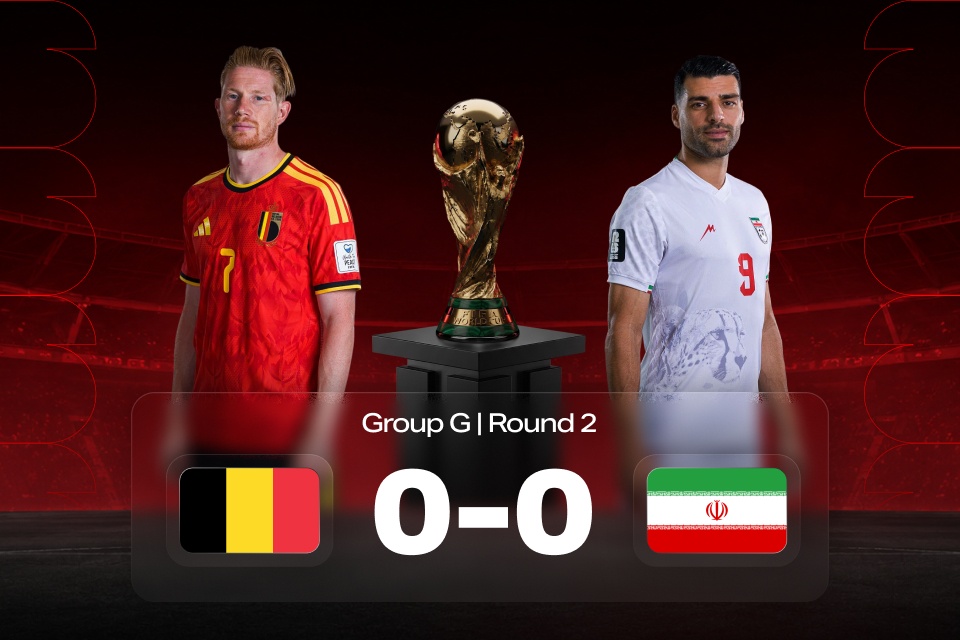


Before kick-off, Belgium were clear favourites at 1.47, and the 888STARZ line showed strong market confidence. After their draw with Egypt, Belgium needed a win to regain control of the group and ease concerns after their opening match. The draw was priced at 4.78, while Iran were listed at 8.00 to win.
But the match did not follow the favourite’s script. Belgium had the initiative, applied pressure and were more often closer to scoring, but they could not break Iran down. The main figure of the game was Alireza Beiranvand: his saves kept Iran alive and turned the 0-0 into a result that seriously changes the betting picture in the group.
Iran also had their moment: Taremi’s goal was ruled out after VAR for offside, while in the second half they gained a numerical advantage after Nathan Ngoy was sent off. But even against ten men, Iran could not turn that spell into a winning goal. The final 0-0 was not a match without events — it was a match about unconverted pressure, a major goalkeeper performance and another reminder that a favourite price does not guarantee conversion.
Match: Belgium vs Iran
Result: 0-0
888STARZ odds: 1.47 / 4.78 / 8.00
Goals and Key Moments
No goals — 0-0
Key episodes of the match:
Taremi goal ruled out after VAR
Alireza Beiranvand’s saves
Nathan Ngoy sent off in the 66th minute
Belgium’s final pressure with ten men
The Line Saw Belgium as Strong Favourites
The 1.47 price on Belgium to win showed that the market had strong trust in Rudi Garcia’s team. This was not a cautious line where the favourite had only a small edge. Belgium were expected to control the match, apply pressure and deliver the result.
Iran at 8.00 were clear underdogs, but not hopeless. That price left room for a scenario based on a low block, patience, set pieces, counters and a big goalkeeper performance. The draw at 4.78 may have looked like a secondary market before kick-off, but it eventually became the main value outcome.
Belgium’s problem was that a 1.47 price required more than superiority in play — it required conversion. The team could have possession, shoot, enter the final third and apply pressure, but without a goal, the favourite line quickly lost comfort.
Belgium Pressed, but Did Not Solve the Main Problem
Belgium played like the favourite: they controlled the ball, pushed their attacking line higher, looked for Lukaku and tried to stretch Iran’s defence. But too often, the pressure ended not in a clear goal chance, but in another attack Iran managed to shut down.
That is an important betting signal. Not all dominance has the same value. When a favourite keeps the ball but does not create enough high-quality shots from dangerous areas, the market should gradually reduce trust in the clean match-winner price. Especially when the underdog stays compact and the goalkeeper gets into rhythm.
Belgium could have won this match, but they failed to do the most important thing — score first. And at 0-0, every passing minute was no longer working only against Iran, but also against the favourite. The longer the zero stayed on the board, the further the game moved away from the pre-match scenario.
Beiranvand Turned 0-0 into the Main Story
Alireza Beiranvand became the central figure of the match. His role was not just about “saving shots.” He changed the psychology of the game. Every save strengthened Iran and added more nerves to Belgium.
For betting analysis, this is a key type of match. Sometimes a favourite fails to score because they attack poorly. Here, the picture was more nuanced: Belgium had pressure, but the final barrier kept winning the battle. In matches like this, a strong favourite price starts losing value not because the favourite lacks superiority, but because that superiority is not being converted.
Beiranvand did exactly what an underdog needs against a team priced at 1.47: survive pressure, keep the team in the match and force the favourite to start again after every missed chance.
Taremi’s Disallowed Goal Showed Iran Were Not Only Defending
It is important that Iran did not spend the entire match simply surviving. They had their own moment and even put the ball in the net, but Taremi’s goal was ruled out after VAR for offside.
For the market, that detail matters. Yes, Belgium were the favourites and attacked more often. But Iran still carried a threat in certain moments. And when the underdog is not only defending, but also occasionally reminding the favourite about counterattacks or set pieces, it becomes harder for the favourite to play calmly.
These are the moments that make a clean favourite bet riskier than the price may suggest. One well-timed run, one defensive mistake, one set piece — and the line can flip fast. In this match, Belgium were saved by the offside call, but the episode itself showed that Iran had a way to hurt the scenario.
Ngoy’s Red Card Changed the Match, but Did Not Give Iran the Win
In the 66th minute, Belgium went down to ten men after Nathan Ngoy was sent off. This was the moment that could have turned the match completely. Iran had the numerical advantage, and the pre-match logic around Belgium at 1.47 fully lost its original shape.
But again, the match did not move in the obvious direction. Iran could not sharply increase the pressure and turn the extra man into a run of chances. Belgium, on the other hand, continued to look for the winning goal and still tried to push late.
For betting analysis, this is an important nuance: a red card does not automatically mean value on the team with the extra player. You have to look at who is actually controlling space, who still has structure and who is creating chances after the sending-off.
In this match, the red card made W1 even riskier, but it did not turn Iran into an obvious live pick to win.
Iran Took a Point Through Discipline and Patience
Iran got exactly the result that looked difficult before kick-off, but still realistic. They did not dominate, did not control the match through possession, but they survived the favourite’s pressure, used their physicality, stayed patient and relied on Beiranvand’s big performance.
After the 2-2 draw with New Zealand, Iran needed to show that they could not only play in an open game, but also close space against a higher-profile opponent. The 0-0 with Belgium is a strong argument in favour of that.
For future lines, this means Iran should not be judged only as an underdog that will concede a lot. In the right scenario, they can hold a match, survive pressure and keep themselves alive until the final minutes.
Where the Market Was Right
The market was right that Belgium had more overall quality and were expected to take more of the initiative. The 1.47 price reflected real favourite status: more individual class, more attacking resources and stronger expectations of control.
888STARZ also correctly avoided treating Iran as completely hopeless. A win at 8.00 showed that an upset was only possible through a very specific scenario, but the draw at 4.78 already left room for a defensive result.
The draw turned out to be the market where the underdog logic made the most sense. Iran did not need to win to break the favourite bet. They needed not to concede — and they executed that plan.
Where the Market Underestimated the Match
The main underestimation was Iran’s resilience and the difficulty of Belgium’s finishing. W1 at 1.47 could create the impression that Belgium should find a goal through class. But the match showed that if the favourite is inefficient in the final third, even a strong territorial advantage may not be enough.
The market may have underestimated:
Beiranvand’s ability to keep the match alive;
Iran’s defensive discipline;
the risk of a long 0-0 scenario;
Belgium’s emotional instability in key moments;
the chance that the favourite would press without enough conversion;
value in the draw and Iran’s positive handicap.
The moment after Ngoy’s red card was especially important. Many live markets may have shifted sharply toward Iran, but the match showed that a numerical advantage alone does not equal dominance.
Where the Value Was for Bettors
✔ Before the Match
Belgium to win at 1.47 was logical by status, but not ideal in value. After the draw with Egypt, Belgium needed to win, but they had already shown that they can struggle with converting pressure.
✔ Before the Match in Alternative Markets
The draw at 4.78, Iran’s handicap and the under looked more interesting for those expecting a tight match. Iran did not need to control possession — they only needed to hold their shape and avoid an early Belgium goal.
✔ After 20–25 Minutes at 0-0
If Belgium had possession but were not creating clean chances, value began to move away from W1 toward the draw scenario. The key was not possession percentage, but shot quality and Iran’s shape without the ball.
✔ After Taremi’s Disallowed Goal
That episode showed that Iran could punish Belgium. Even though the goal did not count, the live market needed to pay closer attention to the risk of counters and set pieces.
✔ After Ngoy’s Red Card in the 66th Minute
W1 became even more dangerous. But automatically jumping to an Iran win would also have been too simplistic. The more workable angles were markets against a Belgium win: draw, Iran double chance, and low-scoring scenarios.
✔ After the 80th Minute
The match became a story of late pressure and survival. If Belgium continued to create but Beiranvand stayed in the game, value remained on the draw and low-score markets.
What This Match Means for Future Lines
For Belgium, this is a worrying result. Two matches, two draws — and now the team enters the final round with no room for a calm scenario. The New Zealand match becomes decisive, and the market will take a closer look at Belgium W1, especially if the price is again too short.
The main question around Belgium is not status. The status and player quality are still there. The question is conversion. The team can control a match, but so far they have not shown enough efficiency to turn superiority into confident wins.
For Iran, the 0-0 with Belgium is a strong market upgrade. After two rounds, they remain unbeaten and keep a real chance of a historic group-stage breakthrough. Against Egypt, Iran can no longer be treated as a simple underdog that only defends. They can suffer, hold shape and find moments.
But bettors should not overrate Iran either. The draw with Belgium is not proof of attacking superiority. It is proof of resilience. That means the most interesting Iran markets may not be a clean win, but handicaps, unders and live scenarios where they hold 0-0 or 1-1.
The main betting lesson is simple: a favourite at 1.47 can be right by status, but weak by price if the team is inefficient in finishing. In matches like this, value often sits not with “who is stronger,” but with “who can break the favourite’s scenario.”
Final Thoughts
Belgium vs Iran was a perfect example of the difference between advantage and result. Belgium were the favourites, pressed more often and should have found a goal. But Iran survived, Beiranvand delivered an outstanding performance, and Ngoy’s red card finally broke the comfortable logic around W1.
For the 888STARZ line, this was a match where Belgium’s favourite status made sense in expectation, but not in final conversion. W1 at 1.47 failed, while the draw at 4.78 became the main value outcome of the match.
Iran earned a huge point and kept their hopes of a historic breakthrough alive. Belgium received another signal that control alone is not enough. And bettors got another reminder: if the favourite does not score early and does not turn pressure into quality chances, even a logical line can quickly become a trap.
World Cup 2026 Betting with 888STARZ
Belgium vs Iran showed why World Cup 2026 betting requires more than reading the favourite’s status. The 1.47 price on Belgium looked logical before kick-off, but Iran completely changed the betting map through discipline, Beiranvand and the right defensive scenario.
Follow the 888STARZ line throughout the 2026 World Cup, compare pre-match expectations with real pressure on the pitch and look for value where the market trusts the favourite too quickly.


 UEFA Champions League